
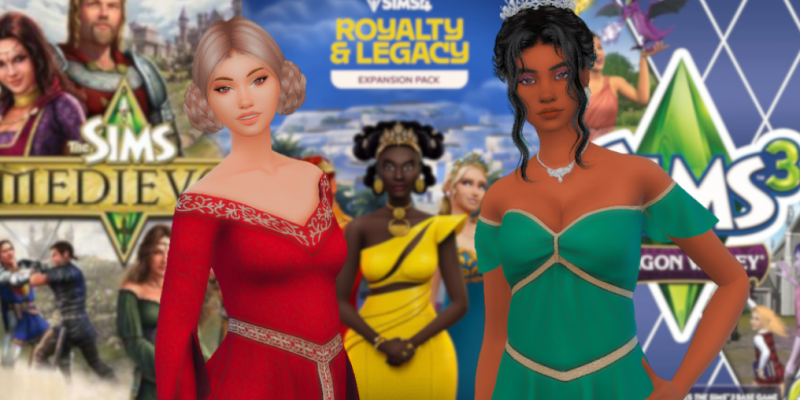
With the official reveal trailer now out for The Sims 4: Royalty & Legacy, the direction is finally clear: this isn’t metaphorical status or social climbing, it’s about monarchy, lineage, and generational power. EA has also confirmed that a full gameplay trailer is coming next, giving us our first real look at how these systems work in practice.
What’s especially interesting is that Royalty & Legacy doesn’t come out of nowhere. In many ways, it feels like The Sims circling back to ideas it’s explored – sometimes boldly, sometimes quietly – across the entire franchise, something the community has been eager for.
Here’s a full look at how royalty and legacy have existed in every era of The Sims, and why this expansion feels like a long time coming.
The Sims Medieval: Royalty as a Core Gameplay System
If Royalty & Legacy has a true spiritual predecessor, it’s The Sims Medieval.
This was the only Sims title where ruling was the point. You didn’t just live in a castle – you governed a kingdom. Playing as a Monarch meant holding court, issuing royal edicts, managing political outcomes, and shaping the future of the realm through quest-driven decisions.
Legacy was built directly into the structure of the game. Certain storylines revolved around securing an heir, strengthening the royal bloodline, or protecting succession. The Pirates & Nobles expansion leaned even further into class divides, court intrigue, and noble identity, cementing Medieval as the franchise’s most explicit exploration of power and lineage.
For many long-time players, this is the reference point Royalty & Legacy will inevitably be measured against.

Sims Wiki
The Sims 3: Medieval Worlds and Player-Defined Dynasties
The Sims 3 never introduced official royal mechanics, but it arguably enabled monarchy-style gameplay better than any mainline entry before or since.
The Store world Dragon Valley provided a fully medieval-inspired setting, complete with stone architecture, old-world layouts, and fantasy elements. Players quickly adopted it as the perfect stage for royal households, noble estates, and kingdom-style storytelling.
This era also marked the rise of structured player-created royal challenges – self-imposed rulesets that divided towns into monarchs, nobles, knights, and commoners, often played across many generations. While none of this was coded into the game, The Sims 3’s open-ended sandbox made these systems feel surprisingly natural.
Royalty in Sims 3 wasn’t official – it was communal, imaginative, and deeply rooted in how players chose to play.
![The Sims 3 Dragon Valley [Online Game Code] : Amazon.co.uk: PC & Video Games](https://m.media-amazon.com/images/I/81PZxxejijL._AC_UF1000,1000_QL80_.jpg)
Sims Wiki
The Sims 2: Where “Legacy Gameplay” Truly Began
Long before royalty became a headline theme, The Sims 2 laid the groundwork for legacy as a defining Sims concept.
This is where the Legacy Challenge was born – a community-driven format focused on carrying one family line forward across ten or more generations. There were no crowns or courts, but inheritance, genetics, memory systems, and family history gave weight to every generation.
Sims 2 made lineage feel important. Choices echoed forward. Family stories accumulated meaning over time. That emotional investment is why legacy gameplay became such a permanent fixture in the Sims community – and why the word “legacy” still carries so much weight today.

hammerxo on Reddit
The Sims 1: Fantasy Aesthetics Before Structure
In The Sims, royalty didn’t exist as a concept – but fantasy certainly did.
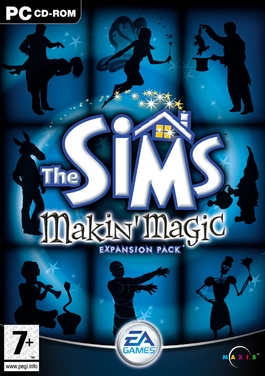
The Makin’ Magic expansion introduced enchanted worlds, surreal objects, and storybook aesthetics that encouraged players to step outside suburban realism. While there were no systems for hierarchy or succession, the tone and visuals planted early seeds for medieval and fairytale storytelling that players would expand on in later games.
Sims Wiki
The Sims 4 Before Royalty & Legacy: Power Without Titles
Before this new expansion, The Sims 4 explored power and status through other lenses.
-
Get Famous introduced a structured fame hierarchy, perks, and reputation – effectively a modern form of social royalty.
-
Vampires leaned into aristocratic themes, ancient bloodlines, and old-world dominance through its vampire hierarchy.
-
Legacy play became one of the most common long-term playstyles, supported by challenges, achievements, and community storytelling.
What was missing wasn’t interest – it was formalisation. Titles, inheritance systems, noble roles, and structured succession were largely left to mods and imagination.

bbqbby on Reddit
Why Royalty & Legacy Feels Like a Full-Circle Moment
With the Royalty & Legacy reveal trailer now live and a gameplay trailer officially on the way, this expansion feels less like a sudden idea and more like a culmination.
The Sims has experimented with monarchy through spin-offs, nurtured dynastic storytelling through legacy gameplay, and explored power through fame and supernatural hierarchies. Royalty & Legacy appears to finally bring those threads together into a single, formal system – one that acknowledges how players have been playing all along.
In that sense, this expansion isn’t rewriting Sims history.
It’s building directly on it.
Are you preparing for the next expansion pack, The Sims 4: Royalty & Legacy? Make sure to check out our Royalty & Legacy hub, dedicated to the best CC, updates and news!
